
Maintaining Hope in Difficult Times
When human beings lose hope, everything changes.
These are difficult times. We are all feeling the pressure in big ways. The challenges of the current global landscape—geopolitical dynamics, the emergence of AI, growing unrest and division, and economic insecurity—are massive. But those things didn’t make life hard. Life has always been hard. The human condition itself predisposes us to a lifetime of challenges.
So, yes, life is hard. But for the most part, humans can handle hard as long as we can see a light at the end of the tunnel. But what happens when we lose hope? Hope for reconciliation. Hope for healing. Hope for repair. That is when humans are at their most vulnerable state.
As a psychotherapist, I have been trained to ascertain a person’s current level of suicidal risk. Guess what the most powerful preventive factor is: hope. While hopelessness alone isn’t a predictor of suicidality, when combined with other risk factors, it increases the likelihood of suicide exponentially.
Why? Because loss of hope represents the ultimate bleakness to a human being. The eternal tunnel of pain. No light. No doors about to open. No help or joy on the other side. No other side, period. Most of us have been there at some point, and it’s a place of emptiness and despair that we would all just as soon avoid.
At this time in human history, it is easy to feel hopeless at times, and it’s hard to see how things can get better. As a result, millions of people the world over are living with crippling anxiety and fears. And, yes, therapy can help. Medication can help. But they alone are not the solution.
That’s because the problem is far deeper than our brain chemistry, past experiences, and belief systems. We need abiding hope to ride out the current storms. Without it, we lose perspective. We focus so intently on the circumstances, and soon they are all we see.
To prevent this darkening of our consciousness, we must learn to possess what I call abiding hope. Abiding hope is hope that remains, no matter what. It lives on the inside of you. And once you have it, it changes your life and your relationship with life forever. However, this is not the hope you have come to know thus far, and changes must be made neurologically in order to possess it.
First things first: hope must be redefined. Defining a term anew is an important part of personal growth work. We often fail to internalize a concept or principle not because it is too hard to do so, but because the language we use to understand it is incorrect. Thus, identifying the errors and revising your current perspective on the matter will be absolutely necessary.
The typical human concept of hope is problematic. Let me give you an example. If you ask me, “Will you be making it to the party tonight?” and I answer, “I hope so,” that sentence does not denote surety. It denotes a fifty/fifty chance—half in the affirmative, half in doubt. If this is the kind of hope we direct toward our desires, needs, and goals, it’s no wonder our results are shoddy at best. This explains why so many of our prayers remain unanswered.
In spiritual texts, when the word hope is used, it does not mean “maybe; maybe not.” In spiritual language, hope literally means “confident expectation.” Thus, from a spiritual perspective, to have hope is to know without a shadow of a doubt that God is working that out—perhaps in His way and His time—but nonetheless, it is not a question of if. It is a question of when.
This kind of hope also extends beyond circumstances. It does not only apply to things that are “not that hard” or to those that your logical mind can accept and understand. This level of hope means that whatever it is—whatever you are believing for—once you believe, it’s done. No doubt exists in your mind. There is one caveat, however, that I would be remiss not to mention: we don’t ALWAYS get what we want. Life is not a genie granting indiscriminate wishes. In those cases, hope means that we will be carried through the experience and that things will work out for our highest good in the end. Because, ultimately, they do.
This is a powerful and miraculous way to live. It opens doors and connects you with possibilities you can’t even imagine. And to the extent that you live this way, to that extent you tap in, and to that extent you will experience life’s miraculous way of meeting your needs and desires. For me, hope is the certainty that whatever problem or issue I may have, the answers and solutions are already on their way. And they always, always come.
Changing your understanding of the word hope from “maybe; maybe not” to “confident expectation” will be the first necessary shift to experience this abiding hope. The second step is creating an internal locus of experience when it comes to hope. Internal versus external locus of control refers to whether you obtain something from outside or inside yourself.
Many spiritual frameworks point to the error and futility of seeking things like esteem, approval, acceptance, validation, security, and happiness from the outside. They teach that it is through the inner journey of life that true meaning, security, and happiness can be found. That is not to say that we cannot find great joy, richness, and meaning in our external experience of life and relationships. Of course we can. It all boils down to what it is you are seeking. Some things are to be met through external participation with life. Some things are not.
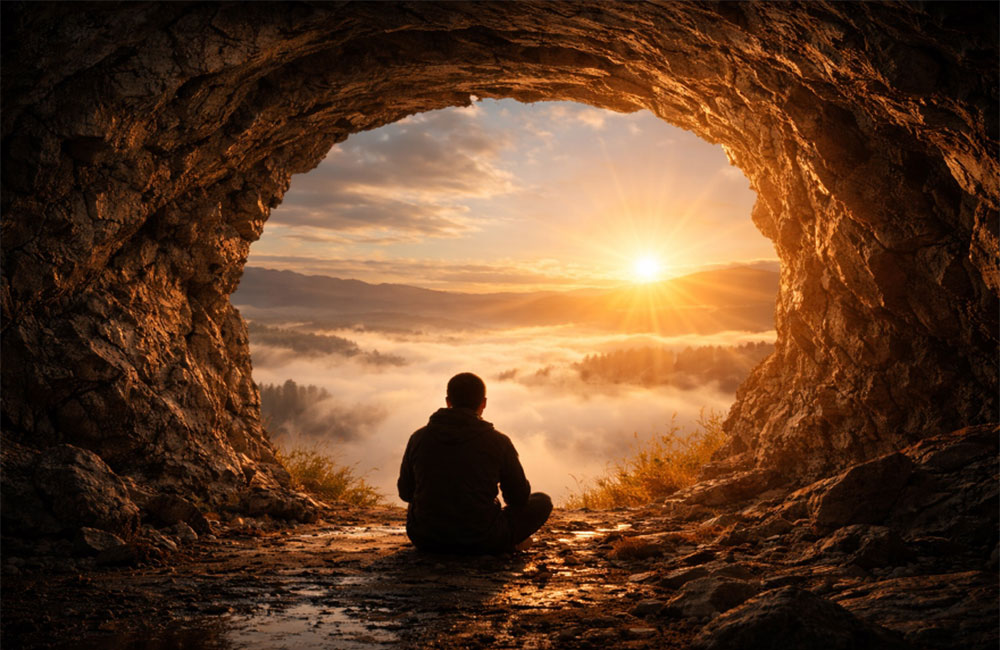
Hope is one of those things that is not. True abiding hope comes from your inner light. It is the light of your soul, your consciousness, and it cannot be extinguished no matter what. Healing and spiritual awakening connect us with this light, which then begins to lead us down a new path—the path of our soul.
Ironically, it is often our painful life circumstances that ultimately connect us with our light. The despair of those tough moments can be the catalyst that allows us to finally seek spiritual help—inner help. The light inside you is also the light of the divine that is as much a part of you as your very breath. Similarly, when everything in our external world seems to be going to hell in a handbasket, that contrast is meant to lead us inward, to the security that can only be found within.
My own journey of healing began in a moment when I had lost all hope to move forward. Thankfully, I reached out and up. As a result, my story is one of healing and transformation, but I know it could have also gone another way.
So, while the mental redefining of hope as confident expectation helps us to extend unwavering faith toward the fulfillment of our desires, becoming one with our inner light allows us to remain connected and at peace while we are in the tunnels of life.
Lastly, remember the famous words from 1 Corinthians 13:13: “And now these three remain: faith, hope and love. But the greatest of these is love.” They say that faith without works is dead. But faith and hope without love are also dead. Love yourself through the storms of life. Let the love of the divine heal you from the inside out. Let others love and support you. There is nothing more powerful, more healing, or more life-changing than love. Love is the highest vibration there is. And it is where all hope can be found.